


A restock order can make sense for inventory and still exceed the cash available to place it. Imagine reviewing a recommendation for two hundred units. The quantity looks plausible. The delivery date is familiar. You are ready to approve the proposal. The detail that changes the decision is in a different file: the order needs four hundred dollars more than the stated cash ceiling, even before delivery charges have been settled.
We are interested in the record beside that decision. An assistant can assemble a convincing explanation while leaving the reviewer to discover the constraint that stops the purchase. The redesign we would rehearse makes that constraint part of the proposed decision itself.
This is also where the company matters. Amazon is already describing tools that can move beyond answering a seller’s questions. Its third-quarter 2026 release reports $201.9 billion of net sales for the quarter ended September 30, compared with $180.2 billion a year earlier. Those are company-wide results, not a measure of what Seller Assistant earns or saves.
The approval is already there
Amazon’s current Seller Assistant announcement describes continuous workflows, seller-defined guardrails and logged actions. Sellers can choose recommendations or actions; Amazon says actions are reviewed and approved before execution. Its selling-partner plugin is described as beta for sellers in U.S. stores. These are company descriptions, not an independent test of a seller’s account.
Source: https://www.aboutamazon.com/news/innovation-at-amazon/seller-assistant-plugin-amazon-quick-claude
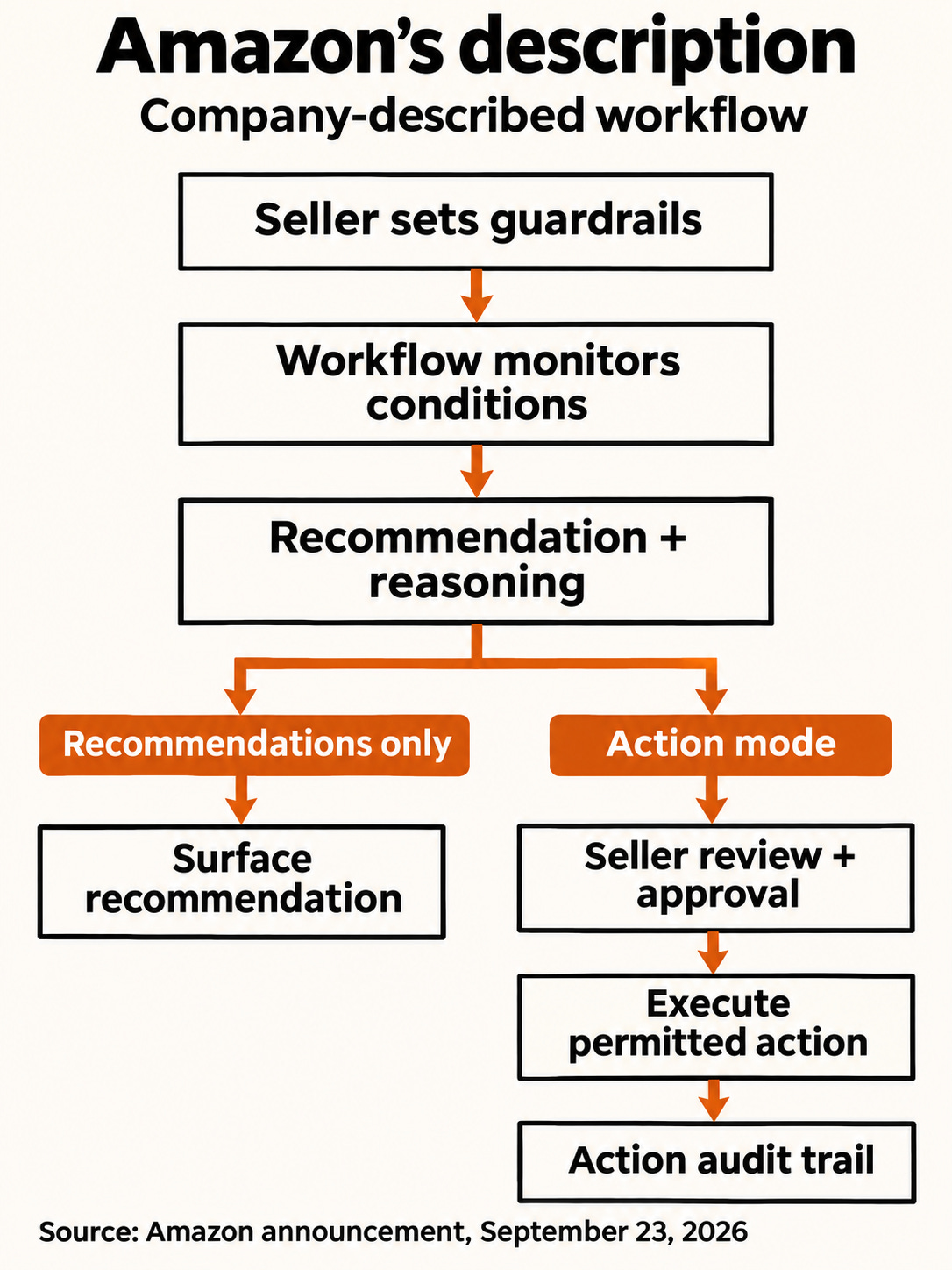
Our proposal starts inside that existing approval process. It asks which facts should travel with a restock recommendation so the reviewer can understand its consequences. We have not connected a seller account, tested the plugin or established which fields its current interface already supplies. The exercise below is a manual decision-record design, with invented inputs.
The cash leaves before the shelf earns
For this rehearsal, treat the proposed stock purchase as an immediate cash commitment. The seller needs to know how much usable stock exists, what is already on the way, when each shipment is expected, and which assumptions generated the proposed quantity. A future sale is not cash already available for this order.
A unit count without arrival timing is incomplete. An inbound shipment can cover a later period while leaving the next few days exposed. A goods subtotal without freight and other relevant charges is also incomplete. The reviewer should be able to see these gaps without reopening every source document.
Here is the invented case. At the start of day one, SKU R1 has fifty usable units. Demand is assumed to be exactly ten units a day. A shipment of 180 units is expected at the start of day six. The proposed new order contains two hundred units and, if placed at the start of day one, is expected at the start of day twenty-one.
The quote says eight dollars per unit and a minimum order of two hundred. The stated cash ceiling for this decision is $1,200. Other charges have not been supplied.
What the recommendation has to explain
Fifty units cover days one through five under the demand assumption. The stock reaches zero at the end of day five. If the existing shipment arrives at the start of day six, its 180 units cover the following eighteen days, through day twenty-three. There is no timing buffer at that first handoff.
Now change one input. Move the existing shipment’s arrival to the start of day nine. Days six through eight have unmet demand of thirty units in this simplified exercise. A new shipment arriving on day twenty-one does not repair that earlier gap. The reviewer needs the two arrival dates kept separate.
Then inspect the cash. Two hundred units at eight dollars require $1,600 in goods. That exceeds the stated ceiling by $400, before any unstated charges. Reducing the order to 150 units would bring goods to $1,200, but would violate the stated two-hundred-unit minimum. A smaller quantity is not an available answer merely because the multiplication fits.
The expected disposition for this fixture is hold. Resolve the cash constraint, the complete landed amount and the existing shipment’s timing before approving the proposed order. We have not calculated an optimal replenishment policy; the example deliberately omits demand variability and a safety-stock allowance.
Put the decision on one page
A proposed approval record could contain these lines:
Proposal: SKU R1, two hundred units.
Inventory: fifty usable now; 180 expected at the start of day six.
Demand assumption: ten units a day, fixed for this rehearsal.
New-order arrival: expected at the start of day twenty-one.
Goods subtotal: $1,600; other charges unresolved.
Constraint: $1,200 cash ceiling; two-hundred-unit minimum.
Timing exception: a day-nine inbound arrival leaves thirty units of unmet demand on days six through eight.
Disposition: hold, with the missing answers assigned for review.
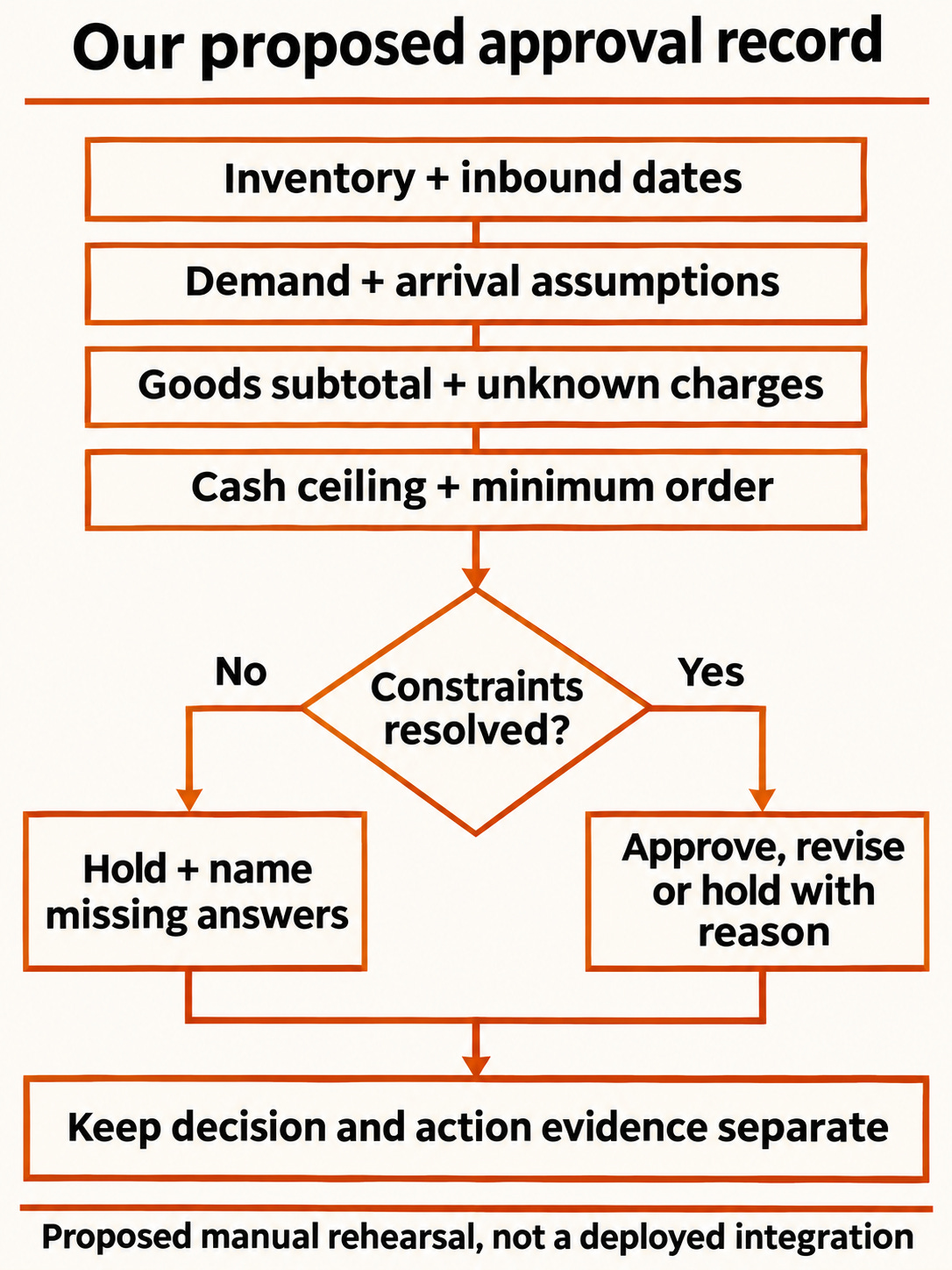
Keep source references and observation times behind those lines. “Fifty in stock” is less useful if the count belongs to yesterday or includes unavailable units. A revised supplier date should remain attached to the earlier estimate so the reviewer can see what changed. The packet should name the decision being considered, not become a second warehouse database.
Rehearse the decision before connecting an action
Start with the filled fictional record. Ask a reviewer to explain the hold using only the packet and its source references. If they have to invent a missing delivery cost or assume a larger cash ceiling, the packet has failed its job.
Next, present the same case with the existing shipment delayed to day nine. Check whether the explanation notices the earlier gap. Record what the reviewer had to look up and which assumption changed the disposition. No live purchase is needed to learn whether the record is understandable.
Only after that rehearsal would we evaluate a real implementation’s data access, freshness and action permissions. The actual seller workflow would need its own verification. Nothing in a neatly filled fictional card proves that an integration reads the right inventory or that an approval produces the intended order.
The support-queue essay asked what the next person needs to finish a job. A restock approval has the same practical demand: bring the decision-changing facts to the person who has to act on them.
https://www.rebuildshow.com/p/shopify-the-ticket-is-classified
For one proposed restock order, write the goods subtotal, unresolved charges, existing inbound arrival and cash ceiling on the same page. Then change the inbound date. Review whether your proposed decision changes for the right reason before connecting any purchase action.
The Rebuild Editorial