


Picture a merchant opening three messages before closing the shop. One asks where a parcel is. One asks to change an address. One asks for a refund. A new assistant has put all three into the right categories. The inbox looks wonderfully orderly. The address still belongs to a parcel that has already left.
That is the small operating problem we’d choose for this rebuild: what reaches the person who must make the decision? We aren’t redesigning Shopify’s internal support organisation or describing a merchant we interviewed. This is a proposed exercise for an imagined merchant using Shopify, built around five fictional tickets.
We want the operator to inherit the evidence, not just a confident label. If the software’s output says “shipping” and leaves someone to reconstruct the request, find the order and discover the exception, the impressive part of the demonstration may have happened before the work began.
Where the business enters the picture
Shopify’s filing for the three months ended June 30, 2026 reports US$802 million in subscription-solutions revenue and US$2,781 million in merchant-solutions revenue, totalling US$3,583 million. Its US$115,567 million in gross merchandise volume is a separate measure of merchant order volume, not company revenue. Merchant solutions include more than payments.
Source: Shopify quarterly filing, June 30, 2026
A merchant uses this support queue inside a wider selling operation. That is why we’d begin with the order and the fulfillment decision rather than treat the inbox as a separate island. The revenue figures give company context; they do not price the merchant’s unresolved ticket or prove our proposal improves retention. We’d need evidence from the actual workflow to make that economic argument.
Start with what the merchant already has
Shopify Inbox offers an optional storefront chat agent. Its documented capabilities include using store information and looking up orders after customer sign-in. Shopify says that when staff handoff is available, the conversation moves to staff with the AI’s prior context; when staff are unavailable, the agent shares the store sender email address. The documentation also specifies new customer accounts and supported plans as requirements.
That changes the starting point for this rebuild. We should inspect what the native handoff already carries, rather than assume the conversation context is missing. Our rehearsal asks whether the particular order state and unanswered question survive into a usable decision packet. We have not tested that end-to-end route.
Source: Shopify Inbox agent documentation
For this proposal, the question is what the operator receives when a case needs attention. Could they see the original request, the relevant order state and the unanswered question together? That is the packet we’d rehearse manually. We haven’t verified a connector carrying incoming Inbox messages into it, and a feature description is not an integration test.
The parcel that already left
Take fictional ticket T002: “Can you change the delivery address on A1002?” The supplied order record says “Dispatched”. The message establishes what the customer wants. The record supplies the order state. Neither establishes which address-change options remain possible.
A category such as “address change” doesn’t settle that. The proposed next move is to ask a fulfillment operator to review the available exception process. The missing fact is the process’s actual capability after dispatch. Keep it missing until someone checks it.
Our decision packet would retain these fields:
Original message | Supporting phrase | Record reference | Known facts | Missing fact | Proposed next action | Owner | Review state
For T002, the filled row would read: original message, “Can you change the delivery address on A1002?”; supporting phrase, “change the delivery address”; record reference, the supplied A1002 order record; known fact, “Dispatched”; missing fact, address-change options after dispatch; proposed next action, review the available exception process; owner, fulfillment operator; review state, decision required.
The record reference stops a remembered fact becoming an untraceable assertion. Supporting text lets the operator see why a request was interpreted a particular way. The review state distinguishes a suggestion from an action that someone has actually completed.
Two proposed operating views
Diagram 1: manual rehearsal. Read the unchanged message, inspect the supplied record, identify the missing fact, choose an owner and record the proposed next action. Keep the gap visible until it is resolved.
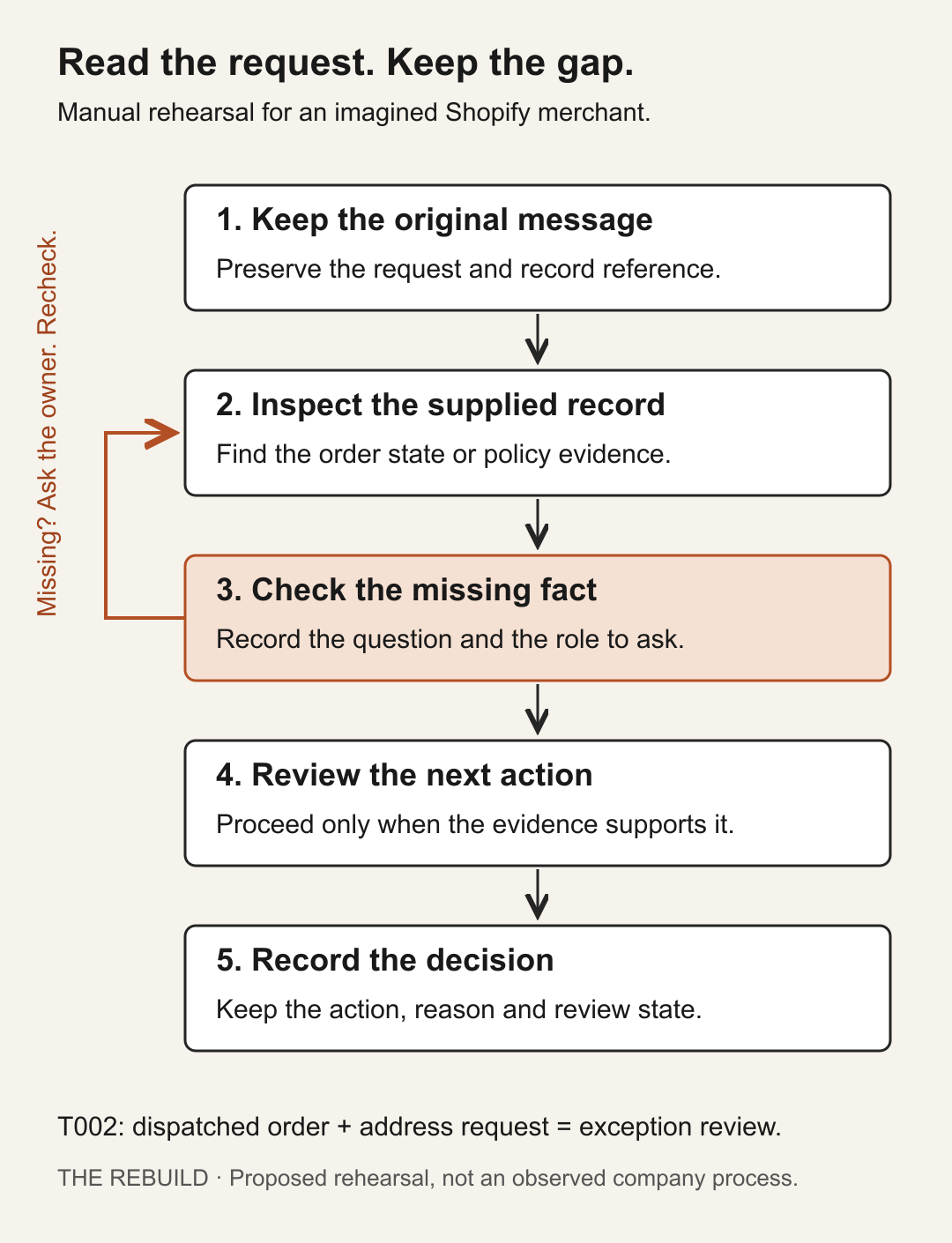
Diagram 2: proposed assisted preparation. Software prepares the request and supporting text, retrieves permitted context and assembles the packet. An operator checks whether the proposed action is supported. Missing evidence returns to review; an approved next move gets a decision record.
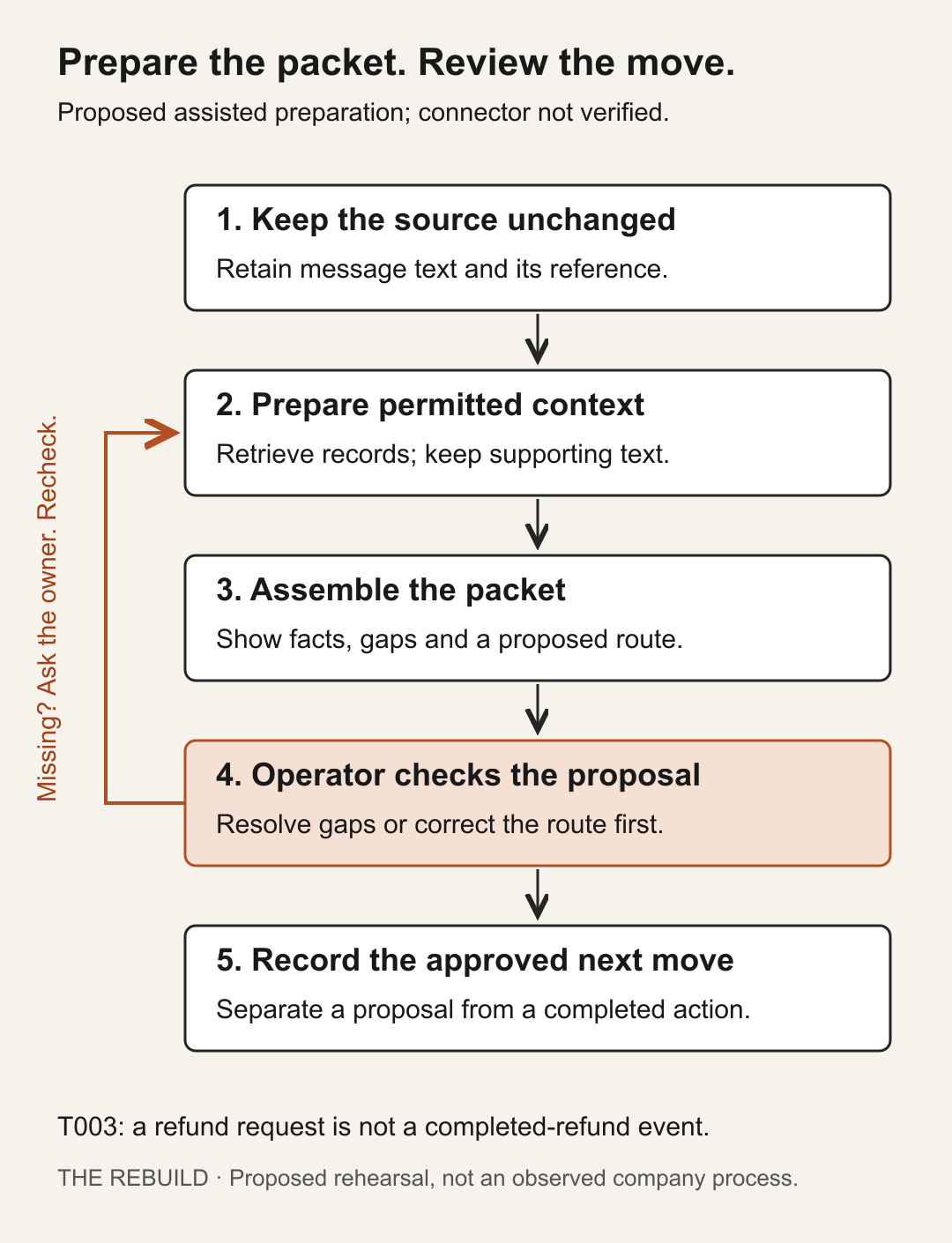
These are operating proposals, not maps of Shopify’s internal practice or a deployed system. In both, the decisive arrow is the one carrying the missing fact back to someone able to settle it. Drawing that arrow doesn’t make the fact available.
A refund request isn’t a refund event
The short refund walkthrough follows the same timing problem one step at a time.
T003 asks for a refund without identifying the order. Shopify Flow’s “Refund created” trigger starts after an order has been partially or fully refunded. It is downstream of the decision this ticket still needs.
Source: Shopify Flow: Refund created
The name is close enough to tempt a hurried integration plan. The sequence is wrong. In this exercise, a support operator first prepares a request for an identifier. There is no identified purchase to review, no approval and no completed-refund event. An automated workflow built around the later event would leave the original question untouched.
The other tickets expose different gaps. T001 has a tracking reference but still needs the current tracking event. T004 asks for policy information; its synthetic policy reference can support a rehearsal, not a working customer link or a return-eligibility decision. T005 may duplicate an earlier request, but both originals remain visible until the relationship is checked.
What the first rehearsal could tell you
Give the five fictional messages to an operator before showing the proposed answer key. Record their initial next action, then the action after inspecting the supplied record. Count decisions changed because of a checked fact or identified gap. Separately count cases still unresolved. A single ticket can belong in both counts.
Those counts would describe the rehearsal. They would not establish hours saved, fewer refunds or a successful AI deployment. Even matching every proposed route would leave a question: could the operator finish the next move with the evidence supplied?
For a later automation test, we’d start with the phrase that makes T002 an exception: the order has been dispatched. The test packet should retain both the address-change request and that supplied state. If either disappears, an operator may be handed an ordinary edit instead of a fulfillment question. Check that small output before asking the system to prepare the whole queue.
For tomorrow, take the T002 example above and fill one packet by hand. Circle the missing fact and name the role that can obtain it. When you return to the row, check whether the next action became possible or merely acquired a better label.
The Rebuild Editorial