

You go to Costco because the trip feels worth it. You pay for a membership, fill a cart, and leave believing you got good value.
Now imagine starting that business today. You still need a building, products people want, and people who can move those products onto shelves. Where would AI help?
We would start behind the scenes: helping the people who decide what to buy, keeping shelves stocked, and answering the questions that make a shopping trip easier.
The goal is simple. Spend less effort running the business so more of that effort can go toward a better deal for the member.
What makes Costco work
A warehouse full of cheap products is only part of the story.
Costco carries a limited selection and buys in large quantities. That gives its buyers a focused job: choose a smaller set of products and negotiate good deals on them. Costco describes its business around low prices, high sales volumes, and moving stock quickly. Costco investor overview
As a shopper, you benefit from some decisions already being made for you. You do not need to compare thirty versions of every product. You need to trust that the one you put in your cart is worth buying.
The membership gives Costco a reason to keep earning that trust. A disappointing trip can cost more than one sale if it makes you question renewing.
The scale is enormous. In fiscal 2026, Costco reported about $297.2 billion in merchandise sales, $5.9 billion in membership fees, and $11.7 billion in operating income, its profit from running the business before interest and taxes. It reported 939 warehouses with those results. Fiscal 2026 results
Here is a simplified picture of how those pieces fit together.
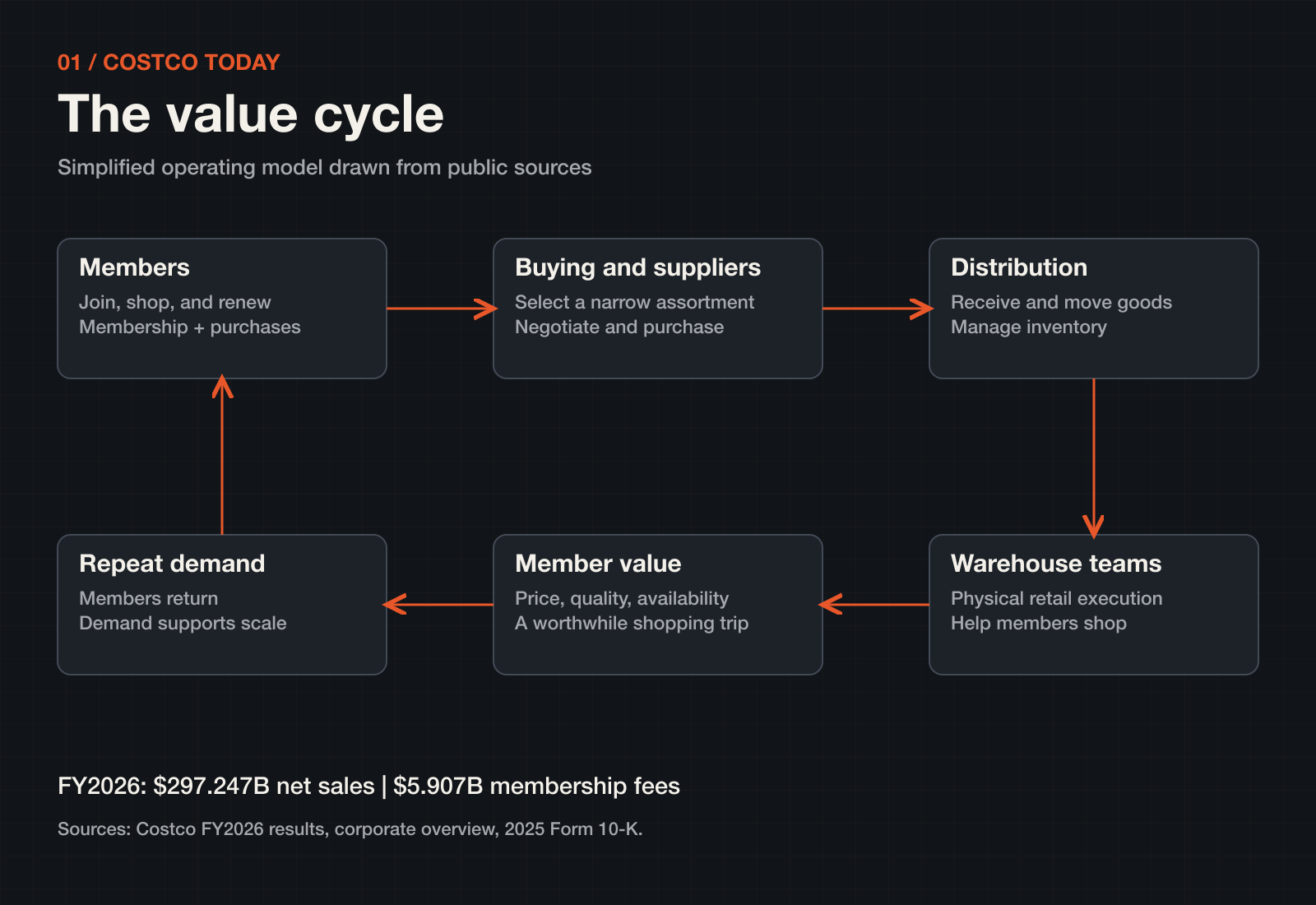
Buy well. Keep products available. Give members good value. They come back, which gives the business more demand to buy against.
That cycle is what we would preserve.
Start with the person buying the products
Imagine you are buying one product for a warehouse. Three suppliers send prices. One quotes twelve items in a case; another quotes eight. Shipping appears in a separate email. The lowest price requires buying more stock than you wanted.
Before you can negotiate, you have to work out what each offer actually costs and how long that stock will last.
This is where we would use AI first.
It would read the quotes and emails, pull the relevant details together, and flag what is missing. A spreadsheet would calculate the prices on the same basis: cost per usable item, including shipping. The buyer would get one clear comparison, with the original quotes next to it.
For example, a cheaper case can become a more expensive purchase when shipping is added. A large minimum order can also tie up cash in products that take weeks to sell.
The buyer still chooses the supplier and negotiates. AI helps them arrive at that conversation prepared.
To find out whether this helps, we would try it on one product category. Does preparing a purchase take less time? Are the numbers right? Did we get the product we wanted at the cost we expected?
Then help the warehouse respond when plans change
Imagine the buyer has placed an order. A supplier emails to say the truck will arrive two days late.
That message affects several people. Someone needs to check the stock already on hand. Someone may need to change the delivery plan. Someone needs to decide whether another order is necessary.
We would connect the supplier message to the order and the current stock count. AI would prepare a short explanation: what changed, which products are affected, and what needs a decision. It could draft the supplier reply too.
The person running the warehouse would have the facts in front of them instead of searching through messages and spreadsheets.
Ordinary forecasting software can handle expected demand. AI is useful for interpreting the messy messages and mismatched records around that forecast.
The test is practical: fewer hours chasing problems, without more empty shelves or wasted stock.
Make the member’s trip easier
Now imagine a member asking: “Is this item available, and where can I find it?”
A useful answer needs current stock information. A friendly answer based on yesterday’s stock count could waste their trip.
We would begin with a few questions the business can answer reliably: availability, product details, location in the warehouse, and straightforward order issues. When the records do not answer the question, the system would pass it to someone who can check.
We would judge it by whether people get the right answer and finish what they came to do. Counting automated replies would tell us very little by itself.
What the rebuilt business looks like
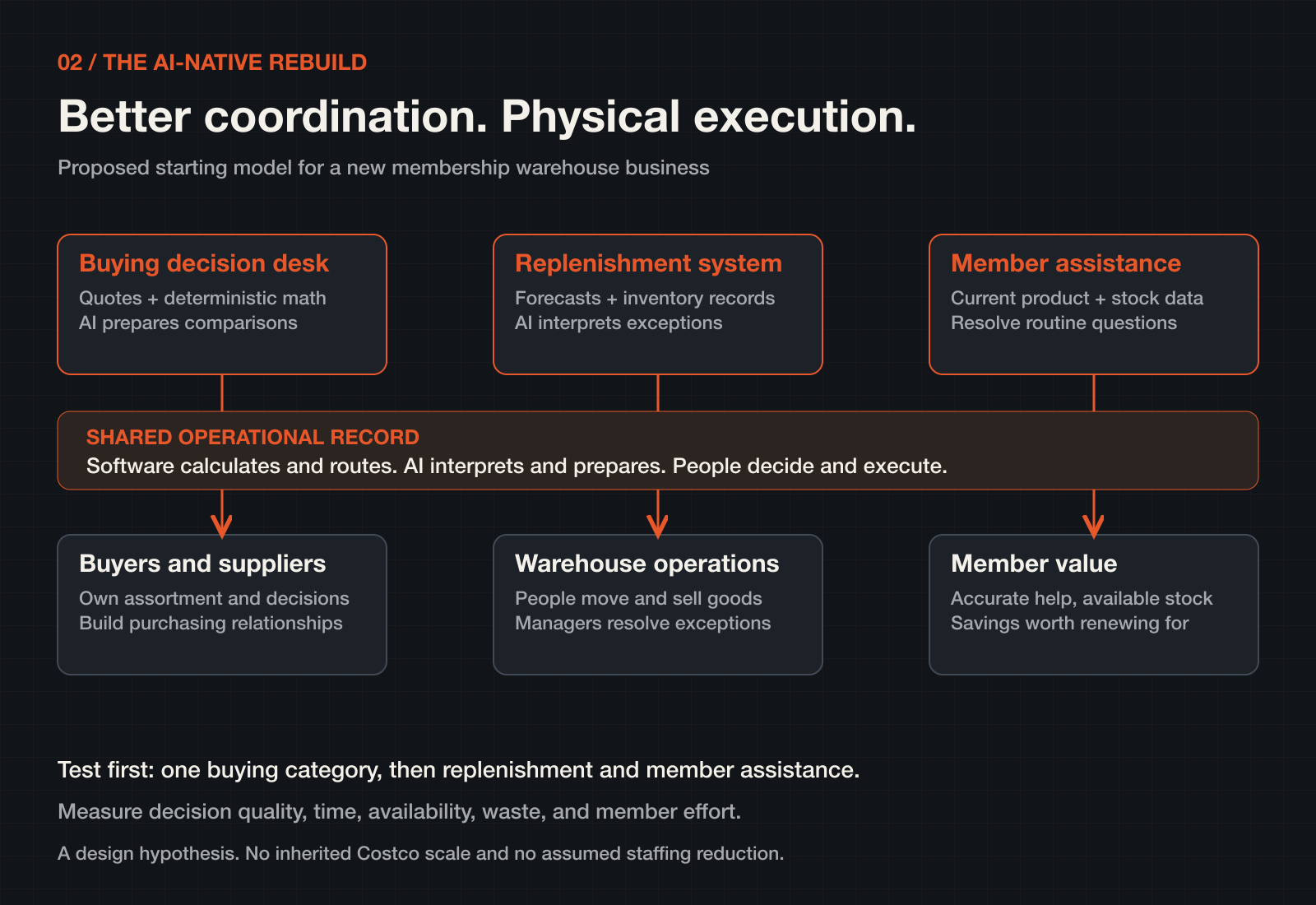
In this version, buying, stock management, and member support use the same up-to-date records. Software does the calculations. AI reads documents and prepares the next step. People make the buying decisions, handle relationships, and run the warehouse.
The physical work remains substantial. Costco reported 341,000 employees at the end of fiscal 2025, with about 95% working in warehouses and distribution. A tool that summarizes an email does not unload a truck. Costco 2025 Form 10-K
For a new business, we would fund the warehouse operation first and build these tools around the people doing the work. As it grows, we would measure whether each location needs less administrative effort to run well.
The hard part AI cannot give you
A new entrant would not start with Costco’s buying power, supplier relationships, buildings, or reputation.
That matters more than the software. A better purchasing tool could save time and still leave the startup paying more for products than Costco does.
So we would start in one market, with a focused selection that gives people a clear reason to join. We would need to prove that members come back and that the business makes money before opening more locations.
AI could help reduce wasted effort along the way. The business would still have to earn its customers.
The idea you can use this week
Pick one decision in your business that starts with scattered information: a purchase, a customer problem, or a delivery change.
Write down what the person making that decision has to gather. Then use AI to help assemble those facts in one place. Keep the calculations visible and the source documents easy to check.
Try it ten times. Include the time spent correcting its mistakes. See whether the person finishes useful work faster and whether the result holds up.
That is where we would begin rebuilding Costco: make buying easier, keep the warehouse informed, and help members have a worthwhile trip.
Which decision in your work starts with scattered information? Leave the job in the comments, in one sentence.
The Rebuild